
Warehouse Inventory Cycle Count SOP
Most inventory accuracy problems don’t come from a lack of counting – they come from counting without a documented process. Barcode Consultants gives you a practical Inventory Cycle Counting SOP framework you can adapt to your own warehouse: what to count, how often, who’s responsible, and how to resolve discrepancies when they show up.
It’s built for warehouse managers and operations leads who already understand the basics of cycle counting and need a structure they can actually implement.

What Is a Warehouse Cycle Counting SOP?
- A warehouse cycle counting SOP is a documented procedure for checking inventory quantities without requiring a full physical inventory count.
- It gives warehouse teams a consistent method for selecting items, preparing counts, verifying quantities, recording results and resolving discrepancies.
- A clear procedure helps employees follow the same counting process across different warehouse locations.
- It also gives inventory managers a structured way to identify recurring errors and improve inventory accuracy.
- Unlike a full physical inventory, cycle counting checks selected products or locations at scheduled intervals.
- Warehouses can therefore monitor inventory accuracy while keeping regular operations running.
- The procedure should define the counting method, employee responsibilities, equipment, inventory controls, discrepancy process and approval requirements.

Difference Between Cycle Counting SOP vs Physical Cycle Count
A Cycle Counting SOP and a Physical Cycle Count are related, but they are not the same thing.
A Cycle Counting SOP is the documented procedure that defines how inventory counting should be performed. A physical cycle count is the actual process of physically checking selected inventory items or locations and recording the quantities found.
Cycle Counting SOP
Physical Cycle Count
Defines the counting procedure
Executes the counting procedure
Specifies what should be counted
Physically counts selected items or locations
Defines count frequency and schedules
Takes place according to the defined schedule
Assigns responsibilities to employees
Employees perform the actual count
Defines counting methods and controls
Inventory is physically verified
Establishes how discrepancies should be handled
Actual discrepancies are identified and recorded
Provides a consistent process across warehouse locations
Provides a consistent process across warehouse locations
The SOP provides the framework, while the physical cycle count provides the actual inventory verification.
For example, an SOP may specify that a particular class of inventory should be counted at scheduled intervals, identify who is responsible for the count, define the equipment to be used and establish the process for resolving discrepancies. The physical cycle count is then performed according to those instructions.
This distinction is important because counting inventory without a documented process can produce inconsistent results. A well-defined SOP gives warehouse teams a repeatable method for selecting items, preparing counts, verifying quantities, recording results and resolving discrepancies.
In Simple Terms
Cycle Counting SOP = How the counting process should work
Physical Cycle Count = The actual inventory counting activity
Count Frequency by Item Class
Not every inventory item needs to be counted at the same frequency. An effective cycle counting SOP should define a counting schedule based on the importance, value, movement and operational impact of different inventory items.
A common approach is to classify inventory into A, B and C categories and assign a different counting frequency to each class.
| Item Class | Typical Characteristics | Counting Approach |
|---|---|---|
| A Items | High-value, high-impact or critical inventory | Count more frequently |
| B Items | Moderate-value or moderately important inventory | Count at a regular interval |
| C Items | Lower-value or less critical inventory | Count less frequently |
The exact frequency should be determined according to the warehouse’s inventory profile and operational requirements. For example, an SOP may specify that A items are reviewed several times during a year, B items at a moderate interval and C items less frequently.

(We will email you the document immediately)
Inventory Cycle Count SOP
- Whether you are performing a inventory cycle count on an entire rack or doing a full wall to wall physical inventory, there are a number of checks and balances that you must put in place in order to guarantee the integrity and accuracy of the process. What you need to put in place may vary based on the features in your Warehouse Management System.
- Our warehouse consulting services include comprehensive warehouse inventory cycle count SOP development and implementation. From assessing warehouse best practices to evaluating warehouse management software, implementing barcode scanning systems, and managing warehouse locations, we offer engagement options to enhance your inventory accuracy processes.
What Belongs in an Inventory Cycle Counting SOP
A useful inventory cycle counting SOP should do more than tell employees to count inventory. It should define the complete process so that different warehouse employees can follow the same method and produce consistent results.
The SOP should clearly document what to count, when to count it, who performs the count, how quantities are recorded and what happens when the physical count does not match the inventory record.
1
Count Frequency by Item Class
2
Items and Locations to Be Counted
Specify how products or warehouse locations are selected for each cycle count. The procedure should identify whether the count is organized by item, SKU, rack location, warehouse zone or another defined method.
3
Counting Responsibilities
Clearly assign responsibility for preparing, performing, reviewing and approving cycle counts. Employees should know who performs the physical count and who is responsible for investigating discrepancies.
4
Counting Method
Document the actual counting procedure employees must follow. This can include identifying the location, verifying the item, physically counting the quantity and recording the result.
5
Equipment and Counting Tools
Specify the equipment required to perform the count accurately. Depending on the warehouse, this may include barcode scanners, mobile devices, inventory counting software, labels or other counting tools.
6
Recording Count Results
Define where and how count results are recorded. The procedure should ensure that physical quantities are captured consistently and can be compared with the inventory records.

Take Cycle Counting from SOP to the Warehouse Floor
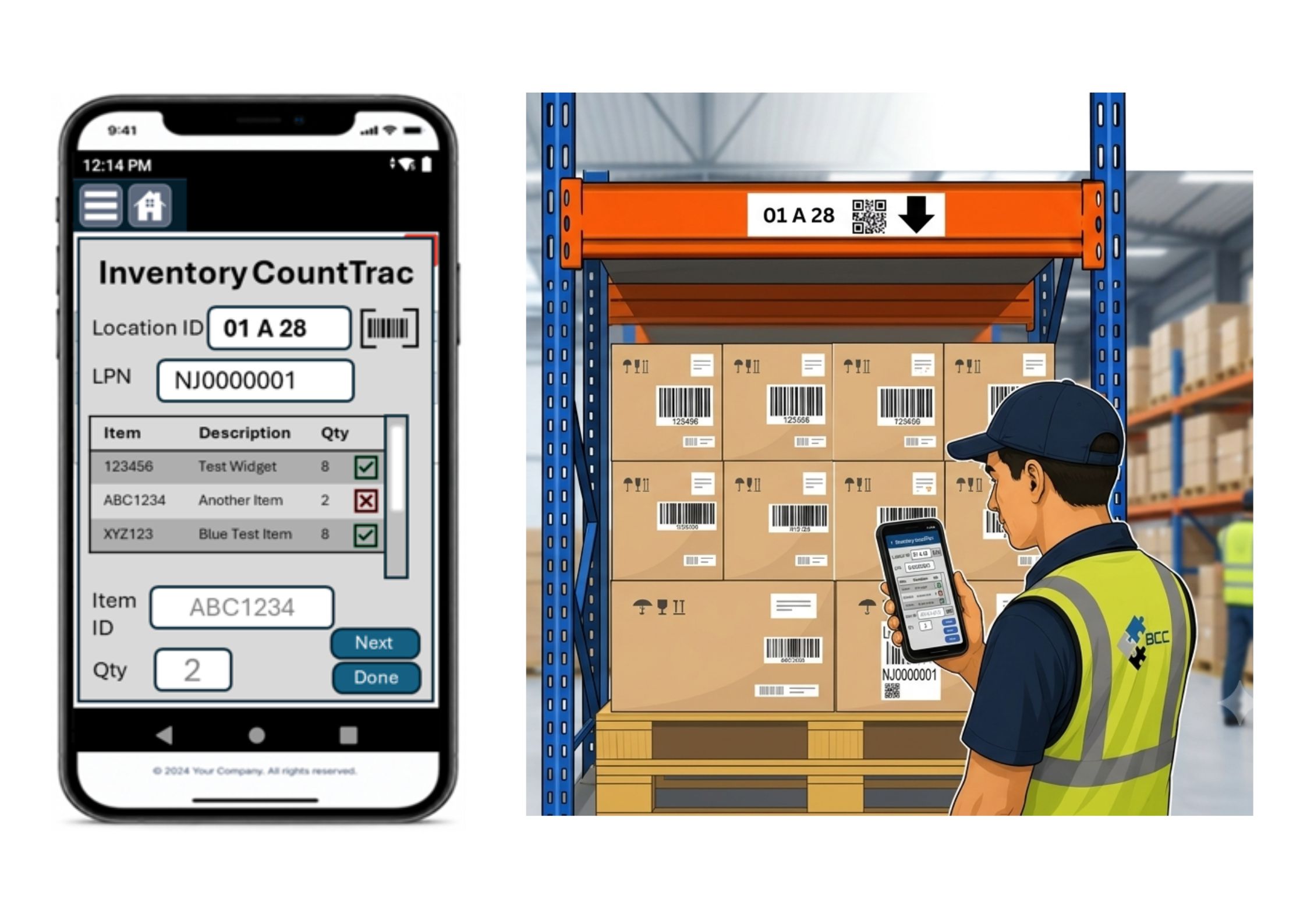
With Mobile Inventory Counting, warehouse personnel can use a mobile device or barcode scanner to identify inventory locations, scan products and record quantities directly while moving through the warehouse.
Instead of relying on paper count sheets and later data entry, mobile inventory counting creates a more direct connection between the physical warehouse count and the inventory record.
01

How Mobile Inventory Counting Supports Cycle Counting
- Scan the Location – Identify the aisle, rack, bay or storage location before beginning the count.
- Scan the Item – Capture the product barcode to reduce manual identification errors.
- Record the Quantity – Enter the physical quantity found at the location.
- Compare Inventory – Identify differences between the physical count and the recorded inventory.
- Record Discrepancies – Document quantity variances for verification and investigation.
- Update Records – Move verified counting information into the inventory management workflow.
02

From a Written SOP to a Repeatable Counting Process
Your SOP defines the process. Mobile inventory counting helps your warehouse team execute that process consistently on the floor.
This is particularly useful when cycle counts are performed across multiple aisles, racks, storage zones or warehouse locations where manually recording and later entering count data can introduce additional opportunities for errors.
Learn how mobile technology can simplify warehouse inventory counting.
Ready to Optimize Your Warehouse Operations?
Talk to a warehouse expert with 30+ years of experience. We’ll assess your current operation and identify your biggest opportunities – no obligation, no generic playbook.
